Dr Duncan James > Explore > Blog
Hike at La Virgen, Sarapiquí, Costa Rica
From the road between San Miguel and Puerto Viejo, including the El Ceibo entrance to Braulio Carrillo National Park.
Any questions? You are welcome to email me at drduncanjames@gmail.com. Because yes, I am an actual human being who has gone to the places described below and can give you first-hand information. Also, I’m friendly and like to chat travel.
Information from 8th November 2026
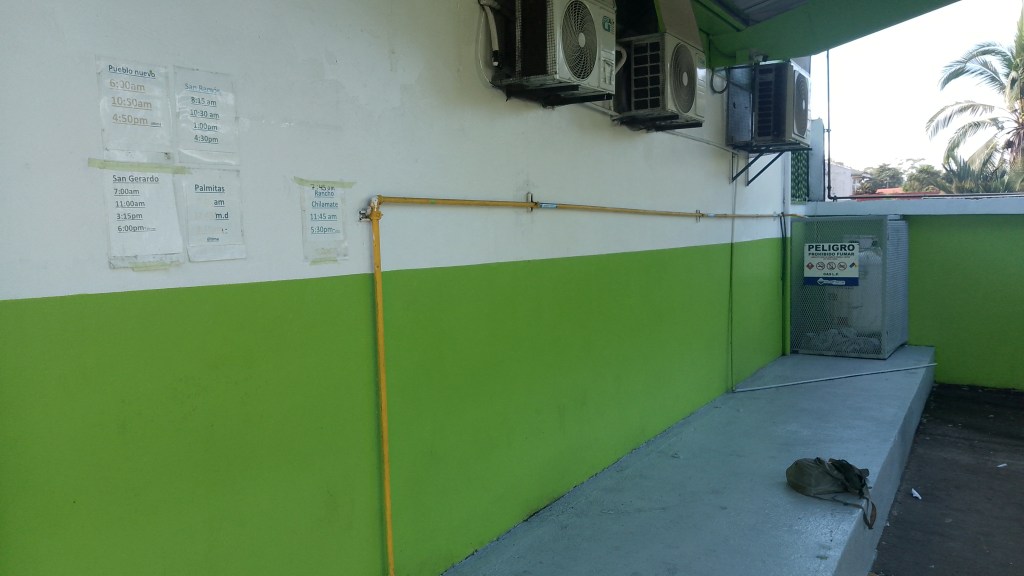
Today I decided to revisit this interesting hike through varied terrain. I waited for a bus in this corner of the bus terminal in Puerto Viaje de Sarapiquí at 10.4548N 84.0094W. And what happened is an illustrative example of how difficult it can be to get reliable bus information. Yesterday I had passed by to verify the bus time, carefully checking these posters.
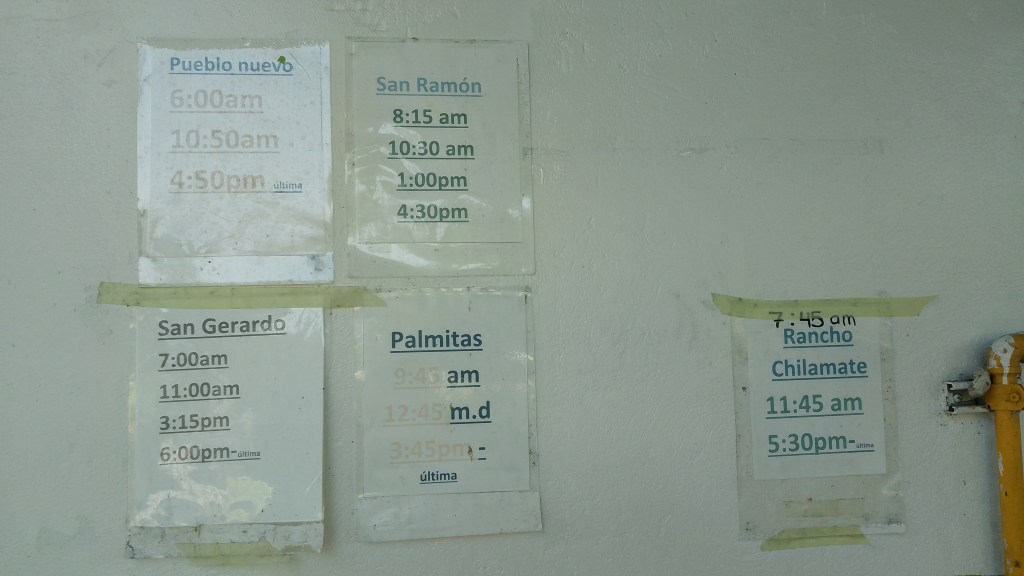
And establishing that the San Ramón bus would be perfect. I even asked a regular passenger to confirm if the posters were up-to-date and if they applied tomorrow (meaning today, a Sunday). Well, turns out these buses do not run on a Sunday. So, after sitting for an hour or so and reading and on-and-off chatting with some other people also waiting for the non-existent bus, I found something else to do for the day.
Information reproduced from my Wild Central America book
The following extract from my book describes an alternative way to explore the same area, without the need to take the San Ramón bus. However, it is similarly more-awkward on Sundays due to the lack of buses.
The start of this hike is a well-known roadside stop among bus drivers. So you can easily get here from, for example, Puerto Viejo on one of the regular buses to San Miguel.
This hike is named after “Pozo Azul” simply because it starts at the giant “Pozo Azul” sign. It doesn’t actually visit the hotel that has this name. It follows a route through the rural roads east of the river towards the national park. You might use this route “as is” or use it as inspiration for designing your own route. I feel that this route is an example that can easily be slightly or heavily adapted. My personal choice of route passes: some protected forest (that belongs to Tirimbina); other forest fragments; some small areas of wetland; farmland and; a couple of small villages. I imagine this area will change over time, for example I was literally walking past deforestation (seemingly to extend an area of farmland) the last time I tried this hike.
This is a relatively flat hike of 16km with only about 300 metres of ascent spread out over the whole distance (and as it returns to the same start point obviously all the ascent is also lost through descent):
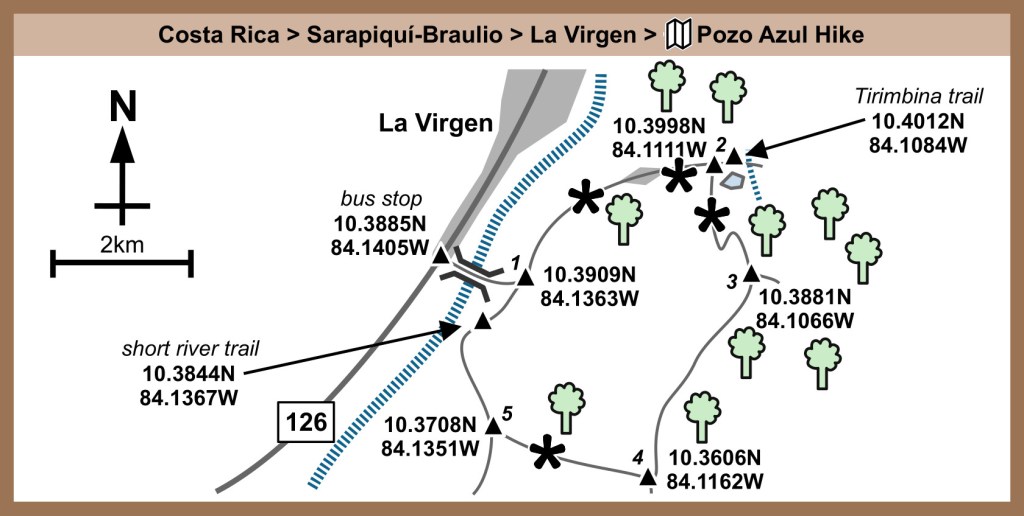
- The bus stop is at 10.3885N 84.1405W.
- (1) Cross the river, reach the junction at 10.3909N 84.1363W and then head north-east. You will discover some river crossings and pass alongside some stretches of river and wetland areas.
- (2) The route reaches a junction at 10.3998N 84.1111W where you can explore onward a little bit to 10.4012N 84.1084W (which for people staying at Tirimbina is one end of a trail). Around here is some good forest habitat.
- Then head south.
- (3) At 10.3881N 84.1066W is a junction where the route continues southward, passing some farms. There are some good views along here. You can look westward for the sequence of peaks that make up Juan Castro National Park, then south-westward for the single peak of Poás Volcano, then southward for the extended triple peak of Volcán Barva and then south-eastward for the sequence of peaks that lie within Braulio Carrillo National Park.
- (4) At 10.3606N 84.1162W is a junction where the route turns westward.
- (5) At 10.3708N 84.1351W is a junction where the route turns approximately northward.
- On the way back to the start, there is a very short trail through some trees with views over river at 10.3844N 84.1367W.
I saw 52 species of birds following this route for 6.5 hours in April:
- Bare-throated Tiger Heron (Tigrisoma mexicanum) 1×2 (m2)
- Cattle Egret (Bubulcus ibis) 1×2 (m2)
- Boat-billed Heron (Cochlearius cochlearius) 1×1 (m1)
- Black Vulture (Coragyps atratus) 3×3 (m5)
- Turkey Vulture (Cathartes aura) 6×2 (m2)
- Red-tailed Hawk (Buteo jamaicensis) 1×1 (m1)
- Black Hawk Eagle (Spizaetus tyrannus) 1×1 (m1)
- Crested Caracara (or Northern Caracara) (Caracara plancus) 1×1 (m1)
- Grey-headed Chachalaca (Ortalis cinereiceps) 1×4 (m4)
- Spotted Sandpiper (Actitis macularius) 1×1 (m1)
- Short-billed Pigeon (Patagioenas nigrirostris) 1×2 (m2)
- Ruddy Ground Dove (Columbina talpacoti) 6×2 (m3)
- Crimson-fronted Parakeet (Psittacara finschi) 1×3 (m3)
- Orange-chinned Parakeet (Brotogeris jugularis) 1×6 (m6)
- White-crowned Parrot (Pionus senilis) 1×2 (m2)
- Great Green Macaw (Ara ambiguus) 1×2 (m2)
- Mealy Parrot (Amazona farinosa) 2×2 (m2)
- Groove-billed Ani (Crotophaga sulcirostris) 4×2 (m2)
- Rufous-tailed Hummingbird (Amazilia tzacatl) 1×1 (m1)
- Collared Aracari (Pteroglossus torquatus) 1×1 (m1)
- Chestnut-mandibled Toucan (or Swainson’s Toucan) (subspecies of Yellow-throated Toucan) (Ramphastos ambiguus) 1×3 (m3)
- Choco Toucan (Ramphastos brevis or Melanerpes pucherani) 3×1 (m1)
- Great Kiskadee (Pitangus sulphuratus) 7×1 (m1)
- Boat-billed Flycatcher (Megarynchus pitangua) 1×1 (m1)
- Social Flycatcher (Myiozetetes similis) 5×2 (m2)
- Grey-capped Flycatcher (Myiozetetes granadensis) 1×1 (m1)
- Tropical Kingbird (Tyrannus melancholicus) 5×2 (m4)
- Yellow-bellied Elaenia (Elaenia flavogaster) 1×1 (m1)
- Common Tody Flycatcher (Todirostrum cinereum) 1×1 (m1)
- Black Phoebe (Sayornis nigricans) 1×1 (m1)
- Northern Rough-winged Swallow (Stelgidopteryx serripennis) 2×2 (m2)
- Southern Rough-winged Swallow (Stelgidopteryx ruficollis) 1×1 (m1)
- Brown Jay (Psilorhinus morio) 1×1 (m1)
- House Wren (Troglodytes aedon) 3×2 (m2)
- Clay-coloured Thrush (Turdus grayi) 10×2 (m2)
- Chestnut-sided Warbler (Setophaga pensylvanica) 1×1 (m1)
- Bananaquit (Coereba flaveola) 1×1 (m1)
- Golden-hooded Tanager (Stilpnia larvata) 2×1 (m1)
- Yellow-crowned Euphonia (Euphonia luteicapilla) 1×1 (m1)
- Blue-grey Tanager (Thraupis episcopus) 5×2 (m2)
- Palm Tanager (Thraupis palmarum) 1×5 (m5)
- Scarlet-rumped Tanager (lumping of Passerini’s and Cherrie’s Tanager) (Ramphocelus passerinii) 12×2 (m4)
- Buff-throated Saltator (Saltator maximus) 1×1 (m1)
- Black-faced Grosbeak (Caryothraustes poliogaster) 1×2 (m2)
- Morelet’s Seedeater (split of White-collared Seedeater) (Sporophila morelleti) 1×1 (m1)
- Variable Seedeater (Sporophila corvina) 5×2 (m3)
- Blue-black Grassquit (Volatinia jacarina) 2×1 (m1)
- Yellow-faced Grassquit (Tiaris olivaceus) 3×2 (m2)
- Melodious Blackbird (Dives dives) 2×1 (m1)
- Bronzed Cowbird (or Red-eyed Cowbird) (Molothrus aeneus) 1×1 (m1)
- Montezuma Oropendola (Psarocolius montezuma) 5×2 (m2)
- Black-cowled Oriole (Icterus prosthemelas) 1×2 (m2)

